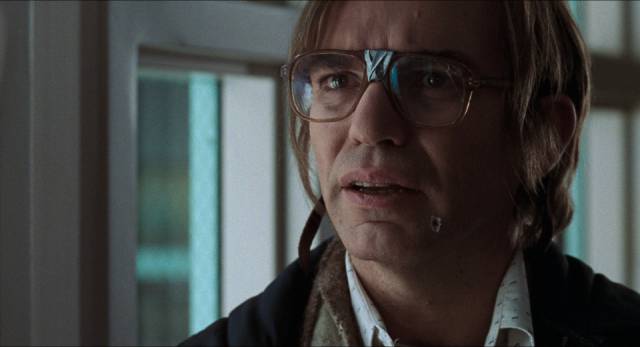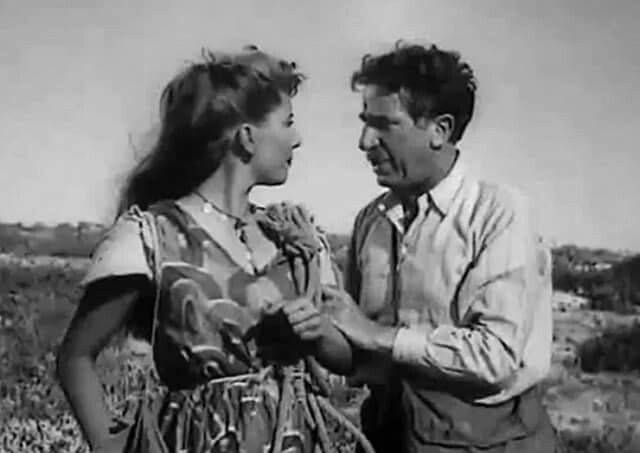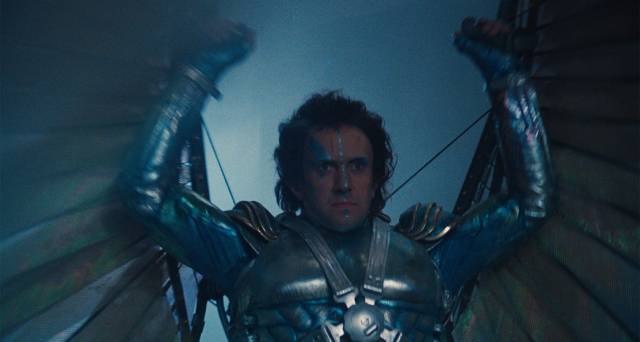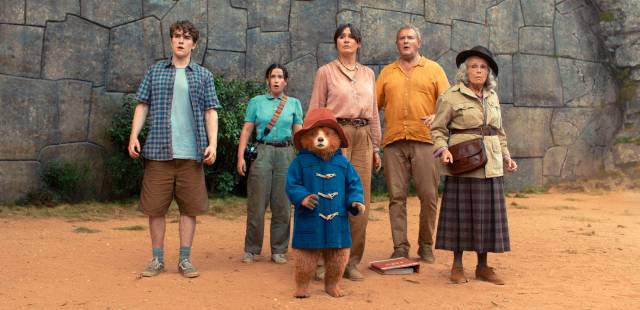
Will this ever end?

Even Benedict Cumberbatch can't save Star Trek Into Darkness from J.J. Abrams' destructive power

Even Benedict Cumberbatch can’t save Star Trek Into Darkness from J.J. Abrams’ destructive power

As my friend Curtis and I both despised what J.J. Abrams, Damon Lindelof and their team did to Star Trek with their “re-boot” (more like a boot to the original’s crotch) in 2009, it would be fair to ask why the heck we decided to go and see the sequel, Star Trek Into Darkness, on opening day. There are actually a couple of answers.

First, given that this will be the cultural behemoth of this summer’s movie season, it would be difficult to complain about it without actually going to see it, so a weary sense of duty gave us a push. But the more compelling reason was the presence of Benedict Cumberbatch, who has quickly become one of the most interesting actors working today. As big fans of his turn as Frankenstein’s creation in Danny Boyle’s recent successful stage version of Mary Shelley’s story, and of course of Cumberbatch’s terrific updating of Holmes in the BBC’s Sherlock, we had some hopes for his villain in the new ST movie.

Suffice to say, there was far too little of Benedict and far too much of J.J. and Damon on show and it’s impossible to avoid SPOILERS in talking about just what makes Into Darkness such a wretchedly tedious experience.

Starting with the poorly written script (Roberto Orci and Alex Kurtzman returning from the first movie, joined this time by the inexplicably high-profile Lindelof, who seems to be determined to single-handedly destroy everything he touches – need I say more than: Prometheus?), the movie is loaded with endless Trek references in the form of “dialogue” which doesn’t sound like anything spoken naturally by actual characters, but simply and repetitively quotes lines from the original TV series and movies to prove that Abrams and his team did bother to watch them before setting out to mess with the franchise. (Abrams was on The Daily Show earlier this week once again pointing out that he was never a fan – perhaps trying to suggest that he was bringing a “fresh perspective”, but instead giving the impression that he feels superior to something which has survived almost half a century as a major pop culture landmark.)

The bad writing undermines the actors’ attempts to create actual characters, resulting instead in a collection of impersonations, adding to the sense that the whole thing is mere pastiche, mocking the franchise while trying to “transcend” it with bigger, louder, longer (seemingly interminable) action/effects sequences. (And what’s with Abrams’ fetish for fistfights on precariously high platforms? He did it twice in the first movie and again at the climax of this one.)

But the bad writing isn’t limited to the dumb dialogue; these guys don’t know how to tell a story. Again and again, the movie has some massive event occur which turns out to have no consequences. When the Enterprise goes to the Klingon home world on a mission which is likely to start an intergalactic war, there’s no sign of the Klingon Empire. We’re told that Kirk and Co have touched down on an “uninhabited” part of the planet. I guess if the Klingon’s flew to Earth and landed in the Mojave Desert, no one would notice because we wouldn’t have any means of detecting their spaceship. But then, a bit earlier, when the villain decides to attack a high level Starfleet meeting with a kind of helicopter, it turns out that Starfleet, located in the centre of San Francisco, has absolutely no aerial defences and apparently anyone can fly an armed vehicle right up to their big glass towers and fire away without hindrance.

In the name of spectacle, Abrams and his team show us battles in which the Enterprise is repeatedly blown to pieces, only to somehow piece itself back together again and again – after being blown apart, there are only a few holes in the hull when the fighting is over. And for the big finale, after having transported 72 photon torpedoes into the villain’s ship and blown it up, the guy suddenly shows up at the end, unhurt, with a mostly intact ship which he crashes into San Francisco. It’s as if the people who made this movie have a weird kind of serial amnesia which makes them forget what just happened in the previous scene … but of course, that – on a much larger scale – is what they did with the first movie, erasing the entire Trek history in order to start their own parallel narrative which can conveniently ignore everything the rest of us have seen (and to various degrees memorized) over more than four decades of viewing.

And yet, having basically invented a new Trek universe, Abrams and crew have made the strange choice to base their second attempt on (BIG SPOILER) the Khan narrative from the first season episode The Space Seed (1967) and the second feature, The Wrath of Khan (1982). So the film is constantly evoking and then immediately violating our memories of the original. By the time we get to Kirk sacrificing himself to save the ship by entering the radioactive core of the warp drive, and we see Abrams et al. “cleverly” reversing the situation from Wrath in which Spock sacrifices himself, we know exactly where the sequence is going and how it’s going to end, forced to sit through fifteen minutes of skewed deja vu for no other reason than that these guys think they’re being clever while actually revealing their total lack of imagination.

Having shit all over Star Trek, Abrams of course is scheduled to take on Star Wars next. The only comfort there is knowing that it will be virtually impossible for him to do any greater harm than George Lucas did himself with the prequel trilogy.

*

Here’s a lengthy review which goes into much more detail about what’s wrong with the movie (with the reviewer being mostly attacked by all the commenters below the review for, apparently, having no sense of fun and “obviously” hating all movies – as usual, if a critic disagrees with you he or she must be an idiot). Although I’m not sure whether it originated with commenter Claude Parish, I was immensely amused by his transformation of J.J. Abrams into Jar Jar Abrams — seems quite appropriate with Abrams’ upcoming Star Wars movies and his exhausting attempts to get people to like him and his work by being as flashy and noisy as possible.

Posted in Uncategorized | Tagged , , , | 3 Comments

Basil Dearden, Humphrey Jennings, and the fires of London

One of the elaborate miniatures from Ealing's The Bells Go Down (1943)

One of the elaborate miniatures from Ealing’s The Bells Go Down (1943)

Growing up in England during the late 1950s and early ’60s, my experience of British film was a mix of now-forgotten B-movies, coarse comedies (I loved the Carry On films, which seem all but unwatchable now), and occasional big productions (Zulu remains a vivid childhood memory). Hammer horror was tantalizingly out of reach, restricted to adult audiences – I can still remember seeing a clip from The Gorgon (1964) on a TV show (I think it was called simply Cinema, part review, part history – it was also where I first saw an excerpt from Wolf Rilla’s Village of the Damned, a film I wouldn’t finally get to see until more than a decade later) and resenting the fact that my older sister had been to see it.

Tommy Trinder as Tommy Turk in The Bells Go Down

Being a kid, of course, I had no thoughts about the character of my national cinema; it was all just movies and I loved being in a theatre watching. Later, as I began to develop a more serious interest in film, I became aware of the low esteem in which British cinema was held … well, at least by the French. It was considered conservative and unadventurous, contributing little to the art of film. But of course, the same could be said for a lot of countries – even France and the U.S. put out a lot of formulaic, commercially-minded product. And England did have its Hitchcock and its Powell and Pressberger (the latter pair often frowned on for being a little, well, excessive). But it’s true that centuries of imperial rule and rigidly defined class structure had their effect on the indigenous film industry – the British valued understatement and knowing your correct place in the scheme of things.

One of Jennings' firemen in Fires Were Started

One of Jennings’ firemen in Fires Were Started

Transgressive work often gets more respect than conformist work, of course, which is why for a decade or so Hammer and its preeminent director Terence Fisher garnered some serious critical attention alongside the unsurprising condemnation from the forces of social order. But there were always others who, while seeming to work within the parameters of that social order, managed to pick away at it to open a few cracks here and there. This was done most aggressively by the British “new wave” filmmakers of the late ’50s and early ’60s, people like Lindsay Anderson, Tony Richardson, Karel Reisz and so on, who shifted attention from the comfortable middle class to the lower and working classes, people fighting against the constraints imposed by a moribund social and political order.

James Mason as Ted Robbins in The Bells Go Down

James Mason as Ted Robbins in The Bells Go Down

But there were other directors who tended to work from the “inside”, trying to shift things with lower-key pressure. Basil Dearden was one of these, best known for films like Victim (1961, a careful, sympathetic treatment of homosexuals when homosexuality was still illegal) and Sapphire (1959, a slightly more melodramatic treatment of racism). These two films came as part of a long career which could be described as intelligently commercial. He made comedies and thrillers and contemporary dramas; his most radical film is probably All Night Long (1962), a fascinating if flawed transposition of Othello to the early ’60s jazz scene in London (with Patrick McGoohan terrific as the Iago figure). (These three, along with his great comedy-thriller The League of Gentlemen, were released by Criterion a couple of years back in an Eclipse set titled Basil Dearden’s London Underground.)

A dispatcher in Fires Were Started

A dispatcher in Fires Were Started

As more and more of Dearden’s work has become available on disk in the past decade or so, moving beyond the better-known films, one of the pleasures I’ve discovered is his consistent sensitivity to place, his use of real locations, mostly in and around London. Apart from the stories themselves (often focused on lower class characters, frequently on the fringes of criminality), this attention to location makes many of his films fascinating documents of the post-war period. The Blue Lamp, Pool of London and Violent Playground in the ’50s, and A Place to Go in the early ’60s contain a strong documentary element which adds weight to their concern with social issues.

By the time of The Blue Lamp, Dearden had been working on his craft at Ealing Studios for a full decade, seeming to try on a number of different styles with varying results. He was one of four directors who created Ealing’s classic Dead of Night ghost anthology in 1945; he directed the studio’s most expensive film to date, and first in colour, Saraband For Dead Lovers (1948, also the studio’s biggest money loser), and the rather dull POW movie The Captive Heart (1946). But until recently I had never even heard of his fourth feature, The Bells Go Down (1943), which I just received on DVD from Amazon UK.

The Blitz: Poetry and Propaganda

The Bells Go Down

The Bells Go Down

Released in May, 1943, at the height of the war and just two years after the events depicted, The Bells Go Down is, to say the least, tonally erratic. Dearden directed the film in the middle of doing a series of Will Hay comedies and the first half fits well within that genre, looking forward to Ealing’s “little England” comedies of the late ’40s and early ’50s. Like those movies – Passport to Pimlico, Hue and Cry, The Titfield Thunderbolt – it posits a nation of small, close-knit communities whose inhabitants pull together for the benefit of all.

Fires Were Started

Fires Were Started

The Bells Go Down was released just a month after Humphrey Jennings’ dramatized documentary Fires Were Started, so that acknowledged masterpiece could not have been a direct influence, yet there are remarkable similarities between the two films and it’s interesting to consider them side by side. Both deal with units of the Voluntary Fire Service at the start of the Blitz, Germany’s air assault on civilian England which began on September 7, 1940, after the failure of the Battle of Britain to break British resistance. Jennings’ film, however, takes place over a single day and night, while Dearden’s covers a longer period.

The Bells Go Down

The Bells Go Down

In the opening moments of Bells, Dearden and scriptwriter Roger MacDougall (The Man In the White Suit, The Mouse That Roared, A Touch of Larceny) quickly sketch in the community – a “village” in London’s East End, with a chip shop, a street market, a pub – and introduce us to three characters, two of whom decide they need to do their part, the third a petty thief who inadvertently joins them in signing up as he hides from the local constable who wants to arrest him. Jennings, on the other hand, doesn’t spend time on the community, keeping his focus narrowly on the fire station and the men working there; his concern is with the job rather than the individuals performing it.

Fires Were Started

Fires Were Started

Both films start with the introduction of new men to the firefighting crew (roles performed by well-known character actors in Bells, and by actual firemen in Fires). In Fires, this is Barrett (William Sansom), a former advertising copywriter just transferred to the unit. In Bells, it’s Tommy Turk (Tommy Trinder), whose mum runs the chip shop; Bob (Philip Friend); and Sam (Ealing regular Mervyn Johns), the petty thief whose specialty is stealing barrels of Guinness. These three are taken in hand by fireman Ted Robbins (James Mason), a professional who dislikes his assignment to train these amateurs.

The Bells Go Down

The Bells Go Down

Much of the first half of Bells is given to comic business involving these three – the Guinness thefts, Tommy’s purchase of a greyhound pup he hopes to get rich betting on in the local races. But there are darker elements woven through these episodes. Ted’s parents, who own the pub, are against his relationship with Susie (Meriel Forbes), one of the fire service telephone operators who Ted’s mother feels is beneath them; one of the other volunteers, Brookes (William Hartnell – the first Dr. Who), was in the International Brigade in Spain and he tells the others what they can expect from the fascists.

Fires Were Started

Fires Were Started

The first half of Fires, in contrast, details the men practicing with their equipment, while Barrett is shown around the area, which includes docks on the Thames where a ship is being loaded with vehicles and ammunition for transport overseas. The mild dramatic tension between Ted and the recruits is absent here, as Barrett, despite class differences (he is obviously better educated then the rest of the crew) is absorbed quickly into the group. This is the difference between Jennings’ documentary sensibility and the requirements of commercial entertainment.

The Bells Go Down

The Bells Go Down

But these differences all but vanish at the halfway point of both films. With the arrival of night and the sound of air raid sirens, both films become intensely focused on the job these men are required to do. The bombs drop and fires start and the crews are faced with burning warehouses, their work complicated by bombs continuing to fall and water supplies being cut off by explosions. Bells comes into focus at last, and surprisingly takes on much the same power as Fires; the looseness and comedy disappear, along with comedian Tommy Trinder, the ostensible star – he pops up for one or two quick lines just to remind you he’s there, but what matters now is the group as a single interconnected unit performing a dangerous task, reflecting the major themes of British war propaganda, with all classes pulling together in a single cause.

Fires were Started

Fires were Started

There are still stylistic differences, of course. Jennings, influenced by Soviet film, creates a series of monumental images of everyday heroism, his firemen symbolizing the power and determination of ordinary people facing the terror of aerial bombardment; these men go calmly about their work, solving problems, putting themselves in harm’s way to get the job done, sacrificing themselves for the sake of their mates. Dearden also deals with these narrative elements, but he builds them into an impressive action sequence which must have used every resource Ealing had available: documentary footage of fires is blended with live action location work, shots staged in the studio with rear-screen projection, and some very large and elaborate miniatures. While it lacks Jennings’ poetry, Dearden’s extended action sequence is a thrilling piece of entertainment with some implausible but nonetheless emotionally resonant bits of “drama” mixed in.

The Bells Go Down

The Bells Go Down

Finally, both films climax with the death of a fireman – surprising and unexpected in Bells; matter-of-fact and inevitable in Fires – and end with the exhausted calm of morning and the people of the city gradually emerging into the shattered streets.

The Bells Go Down is in many ways an awkward film, but for all its initial comic bluster and its touches of sentiment, it ends up paying sincere tribute both to the firemen (after their performance during the first night of the Blitz they’re given a new assignment and Ted happily accepts command of these men whom he now respects) and to the city they fought to defend. In effect, this piece of commercially produced home front propaganda has a similar impact to Jennings’ more accomplished, and certainly more artful film.

*

Fires Were Started

William Sansom in Fires Were Started

Fires Were Started (and its slightly longer original version, I Was A Fireman; both available on the BFI’s The Complete Humphrey Jennings Vol 2 Blu-ray), like much of Jennings’ work, is largely shaped by music. Not only does he weave music throughout the film, both background score and diegetic songs, but the film itself is structured in three movements, like a symphony: the long calm opening introducing the men and their work; the intensely dramatic night, full of danger and ultimately death; and the melancholy quiet of the morning aftermath and its contemplation of the cost in lives lost. I can’t help but think that Jennings must have been a major influence on Terence Davies, another poetic filmmaker who uses music to unify his films and to anchor their rich emotional content.

Posted in Review | Tagged , , , , | Leave a comment

Ray Harryhausen 1920-2013

Ray Harryhausen with two of the characters from his final film, Clash of the Titans (1981)

Ray Harryhausen with two of the characters from his final film, Clash of the Titans (1981)

People of a certain age will have indelible memories from childhood which, while they might not have known it at the time, they owe to Ray Harryhausen, who died Tuesday, May 7, at the age of 92. I was too young for his early sci-fi films in the ’50s, but one of my earliest movie memories is of the Cyclops from The 7th Voyage of Sinbad (1958, dir. Nathan Juran). Admittedly, for years I somehow confused that with the bronze giant Talos from Jason and the Argonauts (1963, dir. Don Chaffey) and only managed to sort them out sometime in the ’80s when I got to see both movies again on video.

The Cyclops: Seventh Voyage of Sinbad

The Cyclops: Seventh Voyage of Sinbad

That confusion is indicative of something crucial about Harryhausen’s career as an animator and special effects creator: as remarkable as his work was, it was often contained within interchangeable and, all too frequently, mediocre films. Because Harryhausen was so obsessive about maintaining control of his work, he allied himself with producer Charles H. Schneer, tied to limited budgets and undistinguished directors. For Harryhausen, the movies themselves existed merely as scaffolding for his animation, and so for many of us our memories are of individual scenes, spectacular moments, rather than of the narratives which contained them.

Talos, the bronze giant: Jason & the Argonauts

Talos, the bronze giant: Jason & the Argonauts

But what effects they were! Harryhausen was not only a supremely talented and innovative technician; he was an artist, imbuing his miniature creatures with uncanny life. I pity more recent generations who have grown up on computer generated effects because they seem to reject the kind of work Harryhausen did – stop motion is “jerky”, unlike the weightless fluidity of CG. But the simple fact that that motion was painstakingly created by hand, a frame at a time, is what makes it so creatively satisfying. There’s a tactile quality to these analog creations which is entirely absent from even the very best computer animation. It’s the difference between the artisanal and the industrial; what matters is not superficial slickness but the spirit he imbued into his creatures.

Battle with the skeletons: Jason & the Argonauts

Battle with the skeletons: Jason & the Argonauts

As awkward and naive as many of the films now look, those of us who were touched by Harryhausen’s imagination at the right age will continue to revisit them to experience their magic again.

Posted in Uncategorized | Tagged , | Leave a comment

DVD Review: Masaki Kobayashi Against the System (Eclipse)

Emblem of conspicuous wealth: Yasuko (Keiko Kishi) in The Inheritance (1962)

Emblem of conspicuous wealth: Yasuko (Keiko Kishi) in The Inheritance (1962)

Criterion’s Eclipse line has three general streams: to explore fringe genres, to introduce work by lesser known filmmakers, to present lesser known works by more familiar directors. The latest release, Masaki Kobayashi Against the System, falls into the third category, presenting three early works by the director of the three-part epic The Human Condition (1959-61, previously released by Criterion), plus the film he made the year after completing that masterpiece.

The face of exploitation: Kurita's manager Kyuki (Yunosuke Ito) in I Will Buy You

The face of exploitation: Kurita’s manager Kyuki (Yunosuke Ito) in I Will Buy You

Kobayashi was a leftist opponent of Japanese imperialist militarism who was inducted into the army in the ’30s. Like Kaji, the protagonist of The Human Condition, he resisted promotion; although he had no choice but to serve the Emperor, he refused to give more than the minimum. But despite his leftist sympathies, he had an increasing disaffection for the communist alternative after seeing what happened to Japanese prisoners held by the Russians. Caught between these two poles, he became a humanist filmmaker rather than a political one and many of his films focus on criticisms of Japanese society, while leaving the audience to consider their own solutions for the problems he presented.

Kobayashi apprenticed, and eventually became a director, at Shochiku, the studio of Ozu and Naruse, Kinoshita and Mizoguchi. The house style was largely one of period films, family dramas, and often in the hands of its best directors delicate dissections of Japanese social attitudes. Living through the war and the subsequent American occupation, Kobayashi developed harsher views and the style of the films in this Eclipse set is more aggressive, often paradoxically revealing (like the films of Koreyoshi Kurahara in a previous Eclipse release) the influence of noir and jazz imported from the States. These films are full of dark shadows and moral ambiguity, virtually every character touched to a greater or lesser degree by the social corruption which followed the collapse of the Japanese Empire.

The Thick-Walled Room (1953/56)

Rigged trial

Rigged trial

Following his directorial debut in 1952, with a family-focused comedy-drama, Kobayashi launched his critical work with The Thick-Walled Room (1953), a film which so troubled Shochiku that the studio suppressed it for three years for fear of offending the U.S., even though the occupation had formally ended in 1952. This film, the first scripted by the novelist Kobo Abe, best known for the four features he wrote a decade later for Teshigahara, deals with a very sensitive and troubling subject: Japanese soldiers condemned by the Allies for war crimes. Abe and Kobayashi focus on ordinary soldiers, not figures of higher authority; yet while they do not excuse these men, they use them to draw attention to the hypocrisy which let many of those with more responsibility off the hook.

The prison

The prison

Although the film presents a group portrait, dealing with the occupants of a single prison cell, it eventually settles on the story of one man, Yokota (Ko Mishima). We learn in flashback that on a remote island his commanding officer ordered him to go back and kill a villager who had just shared food with his patrol; Yokota objected because the man had been friendly and helpful, but the officer insisted that he was probably a partisan and would betray them. After the war, Yokota was accused of murdering the man and the officer testified against him, saying that he had killed the villager and stolen his food to keep for himself. The officer went free and Yokota was convicted.

Shochiku’s fears of giving offence arose largely from concern that the film might be seen as justifying or excusing the actions of Japanese soldiers in the Pacific, but while Abe and Kobayashi present these men as trapped within a brutal system which forced them to act barbarically, the filmmakers do not let their characters avoid responsibility; in fact all the men are plagued by their consciences and suicide attempts are fairly routine in the prison.

Hopeless

Hopeless

Kobayashi’s main concern is with showing that the Japanese establishment, having used these men for its imperialist aims during the war, was rebuilding itself in the post-war years by pushing the responsibility for atrocities onto the least powerful participants. There’s a scene in which a high ranking officer addresses the prisoners, making a point of telling them that while he himself is a “political prisoner”, they are common criminals.

The film deals largely with Yokota’s efforts to come to terms with his own guilt and redefine himself outside the identity his society has imposed on him and then betrayed.

I Will Buy You (1956)

Post-war landscape

Post-war landscape

It was three years after the suppression of The Thick-Walled Room, and a retreat to more studio-friendly projects, before Kobayashi made his next attempt at some harsh social criticism. This time, however, he chose a “safer” subject unconnected with the war and recent Japanese history. I Will Buy You (1956) deals with the efforts of scouts for several professional baseball teams to sign up a star college player, Kurita (Minoru Ooki). Kishimoto (Keiji Sada), the ambitious scout for the Toyo Flowers, narrates the story, giving us a protagonist not unlike Tony Curtis’s Sidney Falco in The Sweet Smell of Success, a cynical, driven schemer who never stops to consider the moral costs of his pursuit of money and success.

Kurita (Minoru Ooki)

Kurita (Minoru Ooki)

Paradoxically, by stepping back from the more overt political implications of The Thick-Walled Room, Kobayashi had found a vehicle for examining Japanese post-war society in far more scathing terms. Severed from its past by the war and defeat, the country found itself in a social and cultural vacuum which was now being filled by an obsession with money. Sheer greed drives Kishimoto and his rival scouts, the team managers, and Kurita’s mentor and de facto manager Kyuki (Yunosuke Ito). Set against all this scheming is Kurita himself, who remains something of a symbolic figure, a young guy who loves his game passionately, but as seen through Kishimoto’s eyes stands as an object to be conquered and possessed. Only Kurita’s girlfriend Fueko (Keiko Kishi) seems to hold any moral perspective on events, wanting Kurita to remain unspoiled by the material frenzy around him.

Black River (1957)

The prostitute

The prostitute

Kobayashi’s next film, Black River (1957), broadens its view with a story centred on the inhabitants of a slum building just outside the U.S. Atsugi naval air base. The jazzy score and Saul Bass-like opening titles declare the underlying theme of American influence on post-war Japanese society, the ramshackle apartment building standing in pathetic contrast to the broad gate of the base which always seems to dominate the background. If anything, Kobayashi’s vision here is even more savage than in the previous film; the characters are scavengers around the edges of American wealth, using and abusing each other in their desperate efforts to make a buck.

Shizuko (Ineko Arima)

Shizuko (Ineko Arima)

At the start, student and bookseller Nishida (Fumio Watanabe), moves into the building, observing the squabbling tenants while trying to remain separate from them. He falls for Shizuko (Ineko Arima), a waitress who lives in the neighbourhood; but she has also drawn the attention of local yakuza Killer Joe (Tatsuya Nakadai, who had made his debut in a small role in The Thick-Walled Room and would later star in The Human Condition). Joe schemes with his gang to grab and rape Shizuko; given Japanese social attitudes, Shizuko responds to her own shame by becoming Joe’s girlfriend, while Nishida still pursues her. Meanwhile, Joe and his political boss scheme with the tenement’s owner (Ishizu Yamada in the film’s most grotesque performance, a character so twisted with greed and opportunism that she’s become physically monstrous) to drive out the tenants so that the building can be bulldozed and replaced with a brothel.

Killer Joe (Tatsuya Nakadai)

Killer Joe (Tatsuya Nakadai)

There are many similarities between Black River and Shohei Imamura’s Pigs and Battleships (made four years later), but Kobayashi once again takes a humanistic approach, focusing on the characters and their relationships rather than the more overt political dimensions dealt with by Imamura. The politics are implicit here, but the dramatic interest is in how those politics distort and destroy individual lives.

The Inheritance (1962)

Satoe (Misako Watanabe) & Furukawa (Tatsuya Nakadai)

Satoe (Misako Watanabe) & Furukawa (Tatsuya Nakadai)

The final film in the set, made immediately after the massive four year effort of The Human Condition, reveals a radical shift in style if not attitude. While the ’50s films show the distinct influence of American film noir, The Inheritance (1962) opens with a very European flavour. The clean, dynamic widescreen images track the elegant Yasuko (Keiko Kishi) through streets where traffic is watched over by store windows displaying expensive merchandise. We seem to be in the Japanese equivalent of La Dolce Vita (made two years earlier), but Fellini’s louche decadence seems mild compared to the acid cynicism Kobayashi displays here.

While window-shopping for jewelry, Yasuko is approached by a smiling but somehow threatening man (Jun Hamamura) who insists that she join him for a drink. As they sit in a restaurant, her voiceover expresses her disgust with the man as she drifts into a flashback to a couple of years earlier, when she was the secretary for businessman Senzo Kamara (So Yamamura). This unpleasant man is married to the venal Satoe (Misako Watanabe) and surrounded by sycophants who cling parasitically to him despite his generally abusive behaviour, including the man who has accosted Yasuko in the opening scene, who turns out to be Senzo’s corrupt lawyer.

Echoes of the Sun Tribe

Echoes of the Sun Tribe

Diagnosed with cancer, Senzo gathers everyone together and declares that he is revising his will; a third of his estate will go automatically by law to his wife, but the rest will go to social causes – unless they can track down his three illegitimate children and bring them to him. If he likes any of them, he’ll leave them part of his legacy. This quest unleashes the floodgates of greed in everyone involved, resulting in multiple levels of deception, rape and murder. Perhaps the key image of the film comes quite late, after Yasuko has rejected an envelope full of money which Senzo tries to force on her; as he falls back in his bed, he coughs up thick dark blood over the pristine white envelope.

While Kobayashi had used the wide screen for epic landscape effects in The Human Condition, in The Inheritance, much of which takes place inside small rooms, the carefully composed frames reflect the cramped psychology of the characters, and the episodic nature of the narrative allows the director to play with different styles and genres. There are elements of noir, which is not surprising, but also of the distinct Japanese delinquent genre of “sun tribe” films, epitomized by Ko Nakahira’s Crazed Fruit (1956).

Blood/Money

Blood/Money

The Inheritance shows the increased confidence Kobayashi had gained through the years of making The Human Condition; there’s a visual precision to the film which is combined with a sense of stylistic play which gives The Inheritance an ease which belies the savage darkness of its content. He immediately followed it with Harakiri, his bleak deconstruction of the chambara genre, projecting his dark view of Japanese culture into the past.

*

Criterion’s Masaki Kobayashi Against the System is a valuable addition to their Eclipse line, providing some interesting context for Kobayashi’s better known films.

Not surprisingly, although the transfers themselves are up to Criterion’s usual standards, with rich blacks and fine image detail, the unrestored source prints vary in quality, with the earliest film, The Thick-Walled Room, showing quite a bit of surface damage, and The Inheritance offering the sharpest and cleanest picture. Audio on all the films is clear and accompanied by optional English subtitles, and as usual each film is supplemented by a short but useful contextual essay, in this case by Michael Koresky.

Article first published as DVD Review: Masaki Kobayashi Against the System on Blogcritics.

Posted in Review | Tagged , , , , , | Leave a comment

Miklos Jancso and the abuses of power

The paradox of confinement in open space: The Round-Up (1965)

The paradox of confinement in open space: The Round-Up (1965)

Miklos Jancso is one of the key figures of Hungarian cinema, but my first encounter with his work didn’t go well. In fact, when I saw the first two parts of his unfinished Vitam et Sanguinam trilogy at the 1981 Hong Kong International Film Festival, I so disliked them that I made no subsequent efforts to see any more of his work. Hungarian Rhapsody and Allegro Barbaro were visually stunning with their rich colours and their elaborate, sweeping long-take camera movements, but their content was so abstract, so divorced from any notion of drama, that they left me completely exhausted and irritable. When I read bits and pieces about his work later, the emphasis always seemed to be on these elaborately choreographed movements of abstract masses of people which somehow represented ideas and incidents rooted in Hungarian history. I remained uninterested.

The Round-Up

The Round-Up

But I also occasionally read references to his earlier films which made them sound more intriguing, so when several years ago Second Run in England brought out a box set of three of his films from the ’60s – and since at that time I was rather obsessively collecting more esoteric and unfamiliar DVDs – I ordered a copy. But not surprisingly, it has remained on the shelf while I’ve watched hundreds of other films which had a greater pull on my attention.

Shooting frogs: My Way Home

Shooting frogs: My Way Home

After completing my recent posts about the dialogue I’ve been having with my friend Gord Wilding about the paradoxical difficulty of maintaining a serious interest in watching movies as we bury ourselves in disks and become increasingly distracted by the Internet, I finally took down the set and started watching. And, as I’ve noticed occasionally in the past, having reached and forced myself through a point of resistance, I found myself not merely engaged, but enthralled by two masterful films over two successive evenings.

The Round-Up

The Round-Up

Although both My Way Home (1964) and The Round-Up (1965) shy away from psychologizing their characters, observing behaviour with a cool but intensely focused attention, a kind of scientific detachment, they both engage with the physical and social reality of their respective periods with a committed sense of realism totally unlike the later films’ abstraction.

My Way Home

My Way Home

Stylistically, these films belong firmly to that Eastern European tradition of longer takes and complex camera choreography which create the impression of a fully grounded material world within which the action unfolds, a realism which paradoxically can support all manner of metaphorical content – something clearly seen in the work of Tarkovsky and Jancso’s fellow Hungarian Bela Tarr. In these films, material textures, the subtle qualities of light and weather, are as important as the actions of the human beings whose existence in the spaces depicted is transient and frequently fragile.

My Way Home (1964)

my_way_home_08In Jancso’s third feature, after a decade of shorts and documentaries, a young Hungarian student (Andras Kozak) makes his way across an empty landscape with a small group of people who are suddenly scattered by a troop of mounted Cossacks. As the others are shot, the student is taken prisoner to a camp overseen by Russians. These are the last days of World War Two, and Hungary was an ally of the Nazis. Although we never clearly learn whether the student was in the German army, or in the Hungarian army allied with the Germans, the fact that he’s Hungarian makes him suspect. And yet, in a purely arbitrary moment due to the miscounting of prisoners, the guards turn him loose and tell him to go home.

my_way_home_07Alone, he sets out across that empty landscape, picking up a German soldier’s coat to keep him warm along the way, only to be caught again by different Russians. This time, he is sent away to a small hut where a young Russian soldier (Sergey Nikonenko) tends a herd of dairy cows, providing milk to the local camp every day. Neither of them speaks the other’s language and they have to communicate with gestures and tones of voice. The student tries to run away, unable to read a sign warning of a mine field; the Russian saves him and brings him back. They share a ruined hut, milk the cows together; their initial distrust and uneasiness can’t be sustained in such close quarters and gradually their differences become meaningless – they’re two boys and, with war far away, they become playful, they become friends.

my_way_home_04The Russian saves the student when a small group of Jewish refugees pass on foot and, seeing his German clothes, start to beat him. One day, they see several women bathing in a nearby pool and like two young animals they chase one of them across the rolling hills, but she’s faster and finally gets away.

But the Russian suffers from a belly wound, the bullet still inside him, and he grows sicker, in constant pain. The student is unable to convey the situation to the soldiers who drive by every day to pick up the milk. As the Russian lies in a fever, the student looks for help, coming across several wagons of refugees; unable to communicate with them, he takes one at gunpoint, hoping he might be a doctor, but when they arrive at the hut, the Russian is already dead.

my_way_home_01The student walks away once more, heading for home yet again. Now wearing a Russian coat, he arrives at a railway station where refugees pour out of the surrounding woods to climb onto a train. He pulls himself up onto the roof of one of the cars where an old woman, mistaking him for a Russian soldier, offers him something to eat. But just as the train is about the leave, the people from the wagons he stopped earlier see him and, also thinking that he’s Russian, they pull him off the train and savagely beat him. An aerial shot tracks him as he gets to his feet and starts to run back into the woods, a lone figure in the landscape. In the final shot, he turns and looks into the camera, a boy haunted by experience who now seems terribly old …

In this first masterwork, we can see Jancso’s big theme: the arbitrariness of political violence and the contingency of social identity, a theme more savagely realized in his next film.

The Round-Up (1965)

round_up_12Although The Round-Up retains the sharp attention to the material details of place, this depiction of events following a failed Hungarian uprising against the Austrian Empire in 1848 is more oblique than the earlier film, already hinting at the abstraction of Jancso’s later work. Set in a high-walled prison compound located in an endless plain which perpetually teases with the idea of space and freedom, the action takes on an almost ritualistic rhythm. Austrian officers are looking for the leaders of the uprising and they methodically work on the prisoners, trying to pry bits and pieces of information from them.

round_up_02When they manage to make one man crack and confess to having murdered three land-owners, they tell him that if he can find someone who has killed more, they will let him go. Desperate, the man tries to insinuate his way into the confidence of other prisoners, provoking distrust and contempt. When he finally manages to expose another man who has supposedly killed six, he only manages to get three names from him – not enough to claim his own freedom.

round_up_09The action moves back and forth between the compound, an outlying building where the interrogations take place, and the open plain, Jancso’s camera observing with cool detachment as hope briefly rises and is quickly crushed. A prisoner is turned loose; we watch through a doorway as he starts to run into the vast empty spaces of the plain; as he grows smaller and smaller in the distance a shot is fired by a man unseen just outside the door frame and the prisoner drops to the ground. A peasant woman is savagely beaten by a group of soldiers in an attempt to get one of the uprising’s leaders to expose himself. As she dies, several men throw themselves to their deaths from the compound walls.

round_up_11Eventually, the officers change tactics and, discovering that a couple of the prisoners were in the rebel cavalry, they provide the men with horses to display their riding skills. Impressed, they offer an opportunity to form a cavalry unit of their own, with amnesty for the men who join. The prisoner calls all the men who once followed him out of the crowd … at which point, the rebels now exposed, the Austrians execute them all.

round_up_13The Round-Up is a chilling depiction of the methods by which political control is established and maintained, using men’s strengths and weaknesses against themselves. There is no ideological argument presented; power exists for its own sake, its whims arbitrary and invariably cruel. But like so many films made behind the Iron Curtain, there is an implicit critique of Soviet power disguised by the historical setting. After all, this film was made just nine years after the Russian tanks rolled into Hungary and crushed the revolution of 1956. But already, Jancso is working towards a kind of abstract generalization about the operations of power, anchored here by historic specificity, but by the time of Hungarian Rhapsody and Allegro Barbaro occurring purely in a conceptual space and thus drained of this film’s visceral power.

Posted in Uncategorized | Tagged , , , | Leave a comment

Deconstructing Hollywood … for laughs: Hellzapoppin (1941)

Starlets roasting on an open fire: the opening musical number in Hellzapoppin (1941)

Starlets roasting on an open fire: the opening musical number in Hellzapoppin (1941)

A friend who teaches film to university students occasionally offers a course in comedy. He’d originally thought it would be fun, but was quickly disillusioned. Of course, comedy, more than drama, tends to be specific to its context as jokes are frequently dependent on shared cultural referents. So these student fans of Adam Sandler, American Pie, The Hangover and YouTube hits-to-the-crotch videos turned out often to be unresponsive to things which my friend finds hilarious. They generally hate W.C. Fields, surprisingly laugh at bits of Jerry Lewis … and at what was unquestionably the lowest point of his experience to date, told him that Alexander Mackendrick’s Ealing masterpiece The Ladykillers was the worst movie ever made (all except a few of them walked out of the screening).

Groucho & Chico going to war in Duck Soup

Groucho & Chico going to war in Duck Soup

There has often been a tension in comedy cinema between the genre’s tendency towards anarchy and social disruption and the needs of the business to maintain acceptable standards of order. You can see this played out in the early movies of the Marx Brothers, with their initial films shattering social norms beyond repair. Their first five films, produced by Paramount, are odes to chaos, climaxing with their masterpiece, Duck Soup (1933, directed by Leo McCarey). But their subsequent move to MGM, with Sam Wood at the helm, gave them bigger budgets but less freedom; though A Night at the Opera and A Day at the Races feature some classic Marx sequences, these films seem ponderous compared to the Paramount features and the brothers are too often sidelined by insipid romantic subplots and musical numbers. The bigger studio, in fact, seems to have suspected that they were a little too dangerous and deliberately set out to tame them.

The inimitable W.C. Fields & Mae West in My Little Chickadee

The inimitable W.C. Fields & Mae West in My Little Chickadee

More obviously, performers like W.C. Fields and Mae West were quickly reined in by the Breen Office once the production code came into effect. The anarchic freedom of the silent years – Mack Sennett, Buster Keaton, even Charlie Chaplin – mostly survived in shorts once sound arrived, the flag of disorder perhaps most consistently flown by the Three Stooges. In features, screwball comedies managed to remain subversive while focusing almost exclusively on romantic conflicts, as if their characters were struggling against the conservative constraints of courtship and marriage which were being imposed on them (there are a number of screwball classics in which bourgeois married couples break up, undergo massive confusions, and eventually reconnect … but now on their own terms rather than society’s).

The contemporary comedies enjoyed by my friend’s students offer superficial indications of transgression – generally of the fart joke, bodily fluid, bad language kind – but tend towards a deep conservatism, a re-establishment of social norms as something both necessary and desirable. (Compare these with Bruce Robinson’s brilliant Withnail & I, in which the inevitability of “growing up” and joining society is faced with a deep sense of sadness and loss.)

All of which is a very roundabout way of getting to a movie called Hellzapoppin

Hellzapoppin (1941)

Fun in Hell

Fun in Hell

The narrative core of Hellzapoppin, directed by H.C. Potter in 1941, is a routine musical romance, much like dozens of other program fillers of the period. Jeff Hunter (Robert Paige) loves Kitty Rand (Jane Frazee), the daughter of a wealthy family, but he can’t declare his feelings until he’s made a success of himself with a theatrical revue he’s written; Kitty loves him back, but her engagement to dull Woody Taylor (Lewis Howard) is about to be announced at a big house party at her parents’ estate. Jeff’s friends Ole (Ole Olsen) and Chic (Chic Johnson) are helping him to put on a benefit performance of his show on the grounds of the estate, hoping to impress a famous Broadway producer – if the show’s a success, Jeff can ask Kitty to marry him …

Kitty & Jeff work on the set

Kitty & Jeff work on the set

There are, of course, numerous complications and misunderstandings (when Ole and Chic get the mistaken idea that Kitty is actually a “bad girl”, they set out to sabotage the show to save Jeff from making a “mistake”) and various subplots. The biggest of the latter is the storyline involving Pepi (Mischa Auer), a Russian prince pretending to be a phoney Russian prince (the phoniness amuses the society people he sponges off, where they would have no interest in him if they knew he was genuine) and Betty (Martha Raye), Chic’s brassy sister, whom the prince mistakes for a wealthy heiress.

Ole Olsen & Chic Johnson with the director

Ole Olsen & Chic Johnson with the director

So – nothing particularly original in the story. What makes Hellzapoppin remarkable is the way the story is told. The film was nominally based on a successful Broadway production created by the comedy team of Olsen and Johnson. Apparently, the stage show consisted of a collection of vaudeville acts and musical numbers which the pair would improvise around and comment on. Although there are musical numbers and verbal and physical gags in the movie which hint at those origins, writer Nat Perrin came up with a whole new structure focused on studio movie-making. Not only does that structure literally embody the conflict between anarchy and containment, it also playfully yet incisively deconstructs the mechanisms of studio filmmaking.

Mischa Auer & Martha Raye

Mischa Auer & Martha Raye

I’ve read about Hellzapoppin for decades, but just recently saw it for the first time (thanks to Glenn Erickson at DVD Savant, who passed on a link to a complete copy of the film on YouTube). Although the person who posted it claims that it’s now in the public domain, the quality of the print used for the transfer is surprisingly good and it’s well worth checking out not simply as an historical curiosity, but also as an often inspired piece of – for want of a better word – post-modern (avant la lettre) film-making, foregrounding the processes of its own production.

Ole & Chic talk to the projectionist, Louis (Shemp Howard)

Ole & Chic talk to the projectionist, Louis (Shemp Howard)

The opening title sequence is an elaborate musical number taking place in Hell, with demons tormenting condemned souls with pitchforks and fire. Into this, Ole and Chic arrive in a taxi. As things escalate, the cab explodes … and the pair yell at the projectionist to rewind the film. Up in the booth, Louis the projectionist (Shemp Howard) is having a bit of an argument with a very large usherette he seems to be hitting on, and he responds irritably to the demands of the two guys on screen; but he finally does rewind the scene, which quickly runs backwards to a point before the explosion – then plays again, but with different action … the projector rewriting what we’ve already seen.

Encounter with Rosebud

Encounter with Rosebud

There’s a call for “cut!” and the camera pulls back to reveal a soundstage where the irritable director has had enough. He, Ole and Chic proceed to walk through a series of sets, with their costumes changing to suit each one in a seamlessly fluid sequence which looks very much to have been the inspiration for Chuck Jones’s great Daffy Duck cartoon Duck Amuck! (1953). There are visual and verbal gags on each set. The most notable has them passing an igloo beside which a small sled hangs from a pole above the snow – we see the word Rosebud painted on it and one of the boys says in passing “I thought they burned that”; Hellzapoppin was released less than four months after Citizen Kane.

Elisha Cook Jr as Harry Selby, the writer

Elisha Cook Jr as Harry Selby, the writer

Eventually they end up on another stage where timid writer Harry Selby (Elisha Cook Jr) starts to tell them the story of his script – which is the story of Jeff and Kitty … as he speaks, the opening scene is projected on the wall behind them and Ole and Chic speak with their “on-screen” selves. For the rest of the film, these two characters within the romantic musical keep breaking the fourth wall, talking to the audience and the projectionist, and occasionally the Ole and Chic in the framing studio set-up interact with the “on-screen” events.

Mixing reels

Mixing reels

Various visual gags include (like many classic Warner cartoons) disruptions of the frame, with characters having to communicate across a frame line in the middle of the screen, even using their own strenuous efforts to shift the frame line back into place; the picture turning upside down, freezing, running backwards; at one point the projectionist mixes up the reels and Ole and Chic get caught in a western; a little later one of the Indians rides onto the country house grounds … There are numerous pratfalls (most involving Auer and Raye) and verbal gags (the prince makes his mistake about Betty because of the double meaning of “ice” [frozen water/diamonds]).

The inevitable water ballet

The inevitable water ballet

At one point the camera pans with Ole and Chic as they walk past the swimming pool; when a young woman in a bathing suit appears in the frame, the pan stops and Ole and Chic walk out of frame. Beat. They come back and yell up at the projectionist to keep his mind on what’s important and the pan continues. This confusion – or conflation – of the camera with the projector occurs several times in the movie, blurring the lines between production and exhibition … and suggesting that the act of viewing is not passive, that despite the assumption of control that the filmmakers might possess, an audience’s eyes are free to pick and choose what they focus on.

Two halves don't quite make a whole

Two halves don’t quite make a whole

In the climactic sequence, Ole and Chic attempt to disappear with the help of the constantly changing detective Quimby (Hugh Herbert), who has appeared as a running gag throughout the movie. It turns out that he’s actually a stage magician and he shows the pair how to “disappear” literally, although things go wrong and one of them vanishes from the waist down, the other from the waist up. This provokes some impressive visual gags from Universal’s brilliant effects man John Fulton in which the two half bodies keep appearing to complete each other, only to drift apart again.

The Lindy Hop

The Lindy Hop

Jeff’s show is a rather bland musical revue with Busby Berkeley-esque numbers, contrasted at one point by a high energy dance number spontaneously performed backstage by the “Negro help” (Whitey’s Lindy Hoppers). The show itself is disrupted and transformed by various intrusions engineered by Ole and Chic, reflecting the constant disruptions of the movie narrative – but those disruptions actually turn the mediocre show into something inadvertently entertaining, reaffirming the idea that accident and contingency can be more creatively productive than authorial intent. Comedy comes out of the chaos in direct opposition to the forces of control.

Breaking the frame

Breaking the frame

And, in a compounding effect, all the disruptions caused by the meta-narrative devices have the effect of reinvigorating the stale romantic storyline, maintaining viewer interest despite the predictable familiarity, while the film itself never takes it seriously. In fact, as the whole thing finally disintegrates, we end up back in the studio where the director, disgusted with this trite script, shoots the writer.

Jeff & Kitty wait while an audience member gets up and leaves

Jeff & Kitty wait while an audience member gets up and leaves

And so, at the height of the studio system, two vaudevillians and a successful theatre director with a fairly undistinguished movie career gleefully deconstructed the mechanisms of mainstream movie storytelling, exposing the arbitrary elements of a typical narrative … and reconstituting them in such a way that, while revealing their essential silliness, Potter, Olsen and Johnson make them seem fresh and spontaneous. Hellzapoppin works both on the level of chaos and on the level of contained, conservative entertainment … but in the end, unlike too many contemporary comedies, it has no interest in re-establishing social norms.

*

Posted in Review | Tagged , , , , | 1 Comment

Over-consumption and Diminishing Returns Part 2

Kris Kelvin (Donatas Banionis) contemplates the ineffable mysteries of life in Tarkovsky's Solaris (1972)

Kris Kelvin (Donatas Banionis) contemplates the ineffable mysteries of life in Tarkovsky’s Solaris (1972)

Continuing my dialogue with friend Gordon Wilding about the ways in which our relationship to the movies we watch has changed in recent years …

I can look back at the years it took me to “possess” the films of Andrei Tarkovsky, starting in 1975 and ending in the late ’80s – not to mention spanning three continents. Each new encounter was filled with a sense of excitement and anticipation, the feeling that I was adding to an on-going understanding of a great artist’s work; and I would go repeatedly in an attempt to grasp what the films were doing to me (knowing it was his final film, I saw The Sacrifice three times in one week at Winnipeg’s late, lamented Cinema 3). His work holds a crucial place in my experience of the medium, and though I have all his films in my collection and have watched them all several times each since they first appeared on VHS and DVD, I nonetheless feel reluctant to re-watch them at home. It’s as if I’m afraid watching them yet again on TV, even a large HD screen, risks erasing those (already compromised) first experiences I had with them. (And yet I don’t think I’d have any problem if by some miracle someone screened them every year in a theatre; I’d happily go again and again.)

I came to Tarkovsky’s work through seeing Solaris in 1975 in London, attracted by its source in the Stanislaw Lem science fiction novel which I’d read in 1970; I can still recall the impact of its rich, slow rhythms and obscure conversations which pointed to an alternative to the western idea of character-through-action. (Although I eventually discovered that Solaris was far from Tarkovsky’s best work, I still found it hypnotically immersive when I watched the Criterion Blu-ray two years ago.) My next encounters were with two of his masterpieces, both seen in Hong Kong’s Cinema One film club in late ’80 and early ’81 – his overwhelming historical epic Andrei Rublev and his second SF film, Stalker (which I consider his greatest work); then came my favourite Tarkovsky film, the haunting Mirror, which I saw several times in London in 1984, around the same time I first saw Nostalghia (each film helping to illuminate the other); and finally The Sacrifice two years later, here in Winnipeg.

Lost in the Zone: Tarkovsky's Stalker (1979)

Lost in the Zone: Tarkovsky’s Stalker (1979)

Ivan’s Childhood is the only one of his seven features that I’ve never seen on a big screen (in fact, my first encounter was with a rental VHS tape, which makes me shudder now!) and perhaps that’s why, despite its beauty and the richness of its moods, it has had less of an impact on me than the others … that and the fact that it more recognizably belongs to an established genre, the Soviet Great Patriotic War story, and thus seems a little less personal. (Perhaps that’s also why Solaris now seems like one of his lesser films, because it’s constrained by too many genre requirements; Stalker on the other hand, although like Solaris based on a science fiction novel, strips away most of the trappings to become a more internal experience, a philosophical argument between political materialism and an ineffable sense of transcendent spirituality.)

Thinking of the impact these films had on me in the theatre, I wonder what it would have been like to encounter the amazing work of Bela Tarr on the big screen. Damnation, Werckmeister Harmonies and the epic Satantango seem so overwhelming even on DVD that I can only imagine how much more they would have affected me in a theatre … the catch is, I never would have experienced these films at all without home video.

True, I do still encounter films which, like those of Tarr, have a deep impact even on DVD. For some reason, a number of Japanese movies spring to mind – Kobayashi’s monumental humanistic epic The Human Condition, which I first saw about a decade ago; several of Naruse’s subtle dissections of social despair; Yamanaka’s exquisite Humanity and Paper Balloons and Kinoshita’s deeply moving Twenty-Four Eyes. But even these don’t seem to have embedded themselves as deeply into me as films I saw three and four decades ago, because, I think, once again they required less effort to “acquire”.

Bela Tarr's Satantango (1994): the whole world in a village

Bela Tarr’s Satantango (1994): the whole world in a village

GORD: Every movie we watch now is built on an initial early experience/memory. The films are powerful and lasting in our brains. We want to repeat the experience but find the ease and convenience somehow taking away from it. I think there is a need for a concerted effort on the viewer’s part to isolate themselves, to understand the nature of the medium (not the transmogrified mass culture experience of the multiplex/internet/netflix), but the nature of film as a storytelling medium – to sit in front of the film and try (hopefully) to wipe away the film’s source (dvd/bluray/theatre/netflix) and simply see it for what it is.

I think that is very difficult. Watching movies at home is about comfort and zoning out (tied, I think, to early TV watching). So it’s a fight. We want comfort. I want comfort. But looking at “art” is not a comfortable experience; it wants us engaged in it; it demands an emotional investment.

The perfect film is both engaging and exciting but does not overwhelm us. It takes us into a world and involves us in an emotional experience and somehow changes us. It gives us the ability to see an intrinsic and undeniable truth about ourselves. Essentially it can be compared to any relationship we have; it is distant enough to give us a perspective and close enough to allow us an emotional response. Good film allows us the distance to observe and an emotional connection, that is the same as what two people need to live together. It doesn’t numb us or alienate. It allows us to bridge the gap between ourselves and the experience.

Yamanaka Sadao's Humanity & Paper Balloons (1937): the whole world in a village

Yamanaka Sadao’s Humanity & Paper Balloons (1937): the whole world in a village

The movies that have stuck with me for years and still exert a pull when I think of them are the ones which really use the medium to create a “total” experience, a complete world which may or may not have a direct connection to the “real” world … I can still remember the feeling of walking out of the theatre after a matinee, sun shining, and feeling as if the world around me had changed in some way, or wasn’t quite as solid as it tried to seem. I used to feel energized after a movie, subtly changed … but I seldom get that feeling any more because I seldom feel completely enveloped by the experience, even the good ones.

Ironically, my capacity to appreciate this thing which has been so important to me, about which I have felt so passionate for so many years, has steadily diminished in direct proportion with my ability to possess movies as objects. Like the proverbial kid in a candy shop, I have perhaps consumed so much that I’m gradually losing my taste for the treats in front of me.

Posted in Uncategorized | Tagged , , , , | 2 Comments

Over-consumption and Diminishing Returns Part 1

Bleak beauty: the ending of James William Guercio's Electra Glide In Blue (1973)

Bleak beauty: the ending of James William Guercio’s Electra Glide In Blue (1973)

Although I know I’ve enjoyed watching movies pretty much since I can remember, I have few specific memories from childhood. It always amazes me when people have a clear recollection of “the first movie I ever saw” … I know I went to see movies fairly regularly as a child, British B-movies, Carry On films and the like, and I can recall a school outing to see Disney’s Pinocchio when I was probably six (more than the movie itself, I recall the subsequent terror of being told by the teacher to stand in front of the class and tell those who hadn’t made the trip what the movie was about), but there were no big revelatory experiences.

Small, isolated moments include: one image from (I think) Henry Levin’s Genghis Khan (1965) – or maybe it was J. Lee Thompson’s Taras Bulba (1962) – one that sticks out because there was a brief display of bare breasts (a boisterous bath scene) which caused a momentary shock of embarrassment because I was sitting there with my parents. There was the gruesome “steel mare” in Jack Cardiff’s The Long Ships (1964). Then there was the formative moment of watching Robert Day’s She (1965) with statuesque Ursula Andress as a cruelly dominant, sexually powerful anti-heroine (she was tossing slaves down a bottomless well). A few years later, I can remember seeing 2001: A Space Odyssey for the first time in St. John’s, Newfoundland, and a marathon afternoon of the first three James Bond movies with my friend from junior high, Don Sturge. (My first Bond, a few years earlier, was Thunderball in 1965, because it was the first which the British censors permitted kids to see.)

Martin Sheen as self-mythologizing killer Kit in Badlands (1973)

Martin Sheen as self-mythologizing killer Kit in Badlands (1973)

But I don’t think I started taking movies seriously until the early ’70s. Perhaps it has something to do with the age at which I encountered them (and the fact that I’d just moved to a city for the first time, with access to many theatres), but the films that started to appear with the collapse of the studios and a consequent weakening of self-censorship became the ones that defined the possibilities of cinema for me. In retrospect, 1973 was a particularly important year because I can recall seeing in fairly quick succession Martin Scorsese’s Mean Streets, Terrence Malick’s Badlands and James William Guercio’s Electra Glide In Blue. All three (which remain particular favourites) are bleak visions of life on the edges of society, and all three are infused with an exciting energy which is only possible in the medium of film. Light, sound, movement, music, the nuances of performance … all combine to evoke uniquely powerful emotional experiences.

That period, my late teens and early twenties, was generally kind of dark – I was angry and depressed much of the time, and so perhaps particularly susceptible to those movies. The heroes usually died at the end and that played into my own sense of hopelessness: probably the first film to hit me that way was Easy Rider (1969). (I didn’t see Bonnie and Clyde or The Wild Bunch until years later, but they would have fit my mood perfectly.) Of course, I did still enjoy comedies (I couldn’t say how many times I went to see Monty Python and the Holy Grail [1975]), but I was clearly drawn to movies which left me feeling emotionally battered. Altman was good at giving me those final kicks – from 1970 to ’74, one after the other he made Brewster McCloud, McCabe and Mrs Miller, Images, The Long Goodbye and Thieves Like Us – all death-haunted; in 1975 there was Arthur Penn’s brilliant and underrated Night Moves; and in 1971, Peckinpah’s Straw Dogs and Russell’s The Devils … I loved movies that fed my seemingly innate nihilism by emphasizing the pointless futility of existence.

The cold fate of McCabe (Warren Beatty) in McCabe & Mrs Miller (1973)

The cold fate of McCabe (Warren Beatty) in McCabe & Mrs Miller (1973)

*

The reason I’ve been thinking about this recently is a series of emails I’ve been exchanging with my friend Gord Wilding, an artist and production designer whose passion for film equals my own. He initiated the exchange by simply listing a number of his favourite documentaries – films by the Maysles Brothers, Steve James, Chris Marker, Agnes Varda, Werner Herzog, Ross McElwee, Joe Berlinger, Chris Smith, Spike Lee and Andrew Kotting – and asking me if I had any additional suggestions.

I like everything on his list, but immediately thought of others that also excite me: Michael Apted’s 7-Up series, of course; Errol Morris’s work, particularly his masterpiece Fast, Cheap & Out of Control; Wang Bing’s West of the Tracks; Marcel Ophuls’ The Sorrow and the Pity and Hotel Terminus; Hans-Jurgen Syberberg’s monumental Our Hitler and Winifred Wagner; Alexander Sokurov’s Spiritual Voices; and the radical Japanese works of Kazuo Hara (The Emperor’s Naked Army Marches On, Goodbye CP) and Mori Tatsuya (A and A2, an inside view of the Aum Shinrikyo cult).

History as phantasmagoric puppet show: Hans-Jurgen Syberberg's Our Hitler (1977)

History as phantasmagoric puppet show: Hans-Jurgen Syberberg’s Our Hitler (1977)

GORD: Someone should talk about a world where no stone is left unturned in the obscure film canon and the fleeting nature of film-watching has turned in on itself. We have unlimited access, so the nature of one’s connection becomes tenuous. The need to engage at the first screening (may be your last) has gone by the wayside; everything has become (relatively) easily accessible and certainly less special.

As he suggests, our “movie consumption” has been changing in the past few years (or decades). As someone with chronic insomnia, he’s been in the habit of watching and re-watching movies many times over (my own re-watching has been more limited because my obsessive collecting means there are always numerous new films to watch). But of course, in the pre-home video days, this constant re-visiting wasn’t possible. We had to hold a film in our memories rather than on a shelf, reconstructing it in our minds rather than simply popping it into a player and letting it unreel in front of our eyes for the nth time. And, of course, that process could often change and distort a movie, bending it to fit our own moods at the time of watching and later as we revisited it in our minds. We’ve all had that experience of seeing something again years later and discovering that it’s nothing like our memory of it. Before video, we possessed movies as subjective experience rather than as external objects.

Hayao Miyazaki's magical My Neighbour Totoro (1988)

Hayao Miyazaki’s magical My Neighbour Totoro (1988)

Gord’s next email was a more extensive list of some five dozen movies which had had a “fundamental and lasting” personal influence on him: a remarkably eclectic selection ranging from Hayao Miyazaki’s My Neighbour Totoro to Ingmar Bergman’s Fanny and Alexander, from Jia Zhangke’s Still Life to Takashi Miike’s Ichi the Killer, Woody Allen to Andrei Tarkovsky to Paul Thomas Anderson, plus many of Peter Greenaway’s films (a particular favourite of his). There are a number of Eastern Europeans to whom I introduced him: Frantisek Vlacil (Valley of the Bees), Bela Tarr (Werckmeister Harmonies, Satantango), Andrzej Zulawaski (On the Silver Globe). Also David Lynch, the Coen Brothers, Richard Linklater, Robert Altman, Wes Anderson, Gus Van Sant, David Fincher and Lars Von Trier.

GORD: I am trying to remember the things that are influences. I feel it is all slowly slipping away. I worry that the things that interested me are disappearing and being replaced by a website of the month.

It all seems very scattered but I am trying to remember the things that were important to me and retain the feeling that was there when they happened.

Ingmar Bergman's magical memory of childhood: Fanny and Alexander (1982)

Ingmar Bergman’s magical memory of childhood: Fanny and Alexander (1982)

I think this points to the heart of “the problem”: we’re exposed to so much more stuff now, from so many directions, that what we used to carefully store away in our memories is becoming swamped by new input. But that new input doesn’t require the careful processing, the effort to comprehend, which movies once demanded. In fact, I sometimes find it hard to recall what I watched last week when I slumped down in front of my TV after a tiring day at work. I used to be able to recall films in remarkable detail, but quite often now I’ll recall a particularly vivid scene but find it impossible to remember what movie it comes from. What we’ve been doing for decades now, as technologies rapidly develop, is externalizing our memories; whether consciously or not, we’ve come to rely on our electronic devices to do the remembering for us and in the process we’re losing the ability to retain a coherent internal record of our experiences and thoughts.

GORD: Now it seems things are all coming at me very quickly and the effort to process it is too much work, that it is easier to move on to something else instead of considering the thing I am looking at/reading/painting/watching …

ME: I know just what you mean … I try to force myself to do some more serious viewing, but most days I just feel too tired or listless and end up watching an action film or something …

Takashi Miike's grotesquely stylish manga mayhem: Ichi the Killer (2001)

Takashi Miike’s grotesquely stylish manga mayhem: Ichi the Killer (2001)

GORD: I don’t watch an action film but I do find myself distracted by a lot of things when I am watching a “serious” movie. The slightest thing will distract me. I can’t watch a movie at my computer because the opportunity to go online is too distracting. I have to force myself in front of my TV and sit down and watch it, forcing myself to look at it. I turn off the lights and shut down the fish tank and pray the kids don’t get up.

I discovered this very seriously while watching the Alien movies over a few nights. The first one, I sat there and watched, no distractions, really engaged and interested; #2 I wasn’t liking it and was very unengaged and getting pissed off; #3 back to being engaged and #4 I was lost and bored.

[But] I popped on Fanny and Alexander the other night and suddenly it was 4:30 in the morning and I was right in it, all the way through. Same feeling I had coming out of Cinema 3 on Ellice the first time I saw it. I am waiting for that moment again to put in Eraserhead.

I think it’s a combination of getting old and having too much stuff coming in. I think I am not hard-wired for all the info, media, etc, I take in in a day through DVD, Netflix, internet, so I rush through these things and don’t take them in, losing the essence of what attracted me to this stuff in the first place. So I may as well be watching Dukes of Hazzard reruns from my teen years for all the good I glean from this stuff.

Bela Tarr's mysterious Werckmeister Harmonies (2000)

Bela Tarr’s mysterious Werckmeister Harmonies (2000)

ME: Yeah, too much distraction is a big part of it … and just having access to too much stuff all the time (it’s ridiculously counter-productive having a collection like mine: I have about 9000 movies to choose from right in my living room) … also, just sitting alone watching stuff — I find it a lot easier to watch something serious when someone comes over, which gives me a chance to talk about the movie instead of just consume it in passing … guess that’s why people used to form film clubs; sitting home alone you totally lose the social aspect of movie-watching …

GORD: I never enjoyed the social aspect of film watching. I ALWAYS wanted to be alone. The movies I’ve watched, both in theatres and on a TV, have been enjoyed alone, even the big important ones. The experience has always been solitary and talking about it afterwards has always left me cold, like I was trying to re-experience it through talking about it. It paled in comparison. It’s like looking at a painting in a gallery – the last thing you want is to hear someone else’s thoughts. The experience is pretty non-verbal if the film or painting is doing its thing, so … nothing to say.

ME: I think I prefer to watch “serious” films with someone because it kind of forces me to pay attention and then talking about it helps to fix it in my mind …

Frantisek Vlacil's evocation of the harsh Middle Ages: Valley of the Bees (1968)

Frantisek Vlacil’s evocation of the harsh Middle Ages: Valley of the Bees (1968)

But re-reading my last comment, I realize that this certainly wasn’t always true. In fact, like Gord, I used to love being alone in the theatre, just me and the images up on the screen … as someone once said, movies are dreaming with your eyes open; they unfold inside your head. Of course some things are energized by an audience (a good comedy is a lot funnier when shared), but those films I mentioned above, those dark, intense dramas, are places best visited alone. One of the things which triggered my obsession with Eraserhead thirty-three years ago was the way in which David Lynch’s use of sound and image somehow isolated each member of the audience in their own head: it becomes your own dream (or nightmare).

I still love movies that have that power over me (most recently Paul Thomas Anderson’s The Master), but the truth is I don’t often seem to have the patience to let it happen. Or, as Gord points out, movies are now too easily accessible. I don’t have to make an effort to see something; I can just pull it off the shelf and slip it into the DVD player, or call it up on-line. Perhaps we’re conditioned not to value things that come without any effort.

To be continued …

Posted in Uncategorized | Tagged , , | 1 Comment

Roger Ebert 1942-2013

Roger Ebert (r) and Gene Siskel: the two infamous thumbs

Roger Ebert (r) and Gene Siskel: the two infamous thumbs

Anyone interested in movies – and particularly anyone who writes about them – had to take note this past week of the death of Roger Ebert, the Chicago-based movie critic who over fifty years became the face and voice of criticism for a large public. He more or less fell into the role in the ’60s when he was assigned to review movies for the Chicago Sun-Times, which became his professional home for the rest of his life.

Although he won the Pulitzer Prize for his critical writing in 1975, it was the start of his long-time television relationship with fellow Chicago critic Gene Siskel on PBS’s Sneak Previews that same year which became the basis of his strange celebrity status. While there had been prominent and influential critics before this – James Agee, Manny Farber, Andrew Sarris, Pauline Kael, and so on – none achieved Ebert’s public presence. Which is not necessarily to say that he was a better critic than any of them; his position coincided with shifts in the way media functioned – particularly the move away from print to television (and eventually, of course, the Internet).

I used to watch Siskel and Ebert back in the ’70s, always interested in catching clips of movies that hadn’t yet reached Winnipeg, and often amused by the prickly conflicts between the two rivals. I was also intrigued when I realized that this was the same man who had written the script for Russ Meyer’s mad masterpiece Beyond the Valley of the Dolls (1970), something which he never tried to brush off as an indiscretion, but apparently remained proud of even after gaining such prominence.

It was only after the Internet made his written words easily accessible, however, that I actually read much of Ebert’s work. While the TV format often made his opinions seem somewhat facile (the reductionist two-tumbs-up/two-thumbs-down inevitably trivialized the idea of criticism even as the show itself got its audience to actually think about applying critical judgements to what they were watching), his writing reveals a deep passion for film and ultimately that was what sustained his prominent public position.

Even when disagreeing with him, I found his opinions interesting and occasionally illuminating. There’s a certain middle-brow tendency in his work (like many critics, he gave a rave to Anthony Mingella’s insufferable adaptation of The English Patient), and his favourite movie remained Citizen Kane to the end. But he could also surprise with unexpected opinions. I probably became more interested in his writing after he contributed a laudatory commentary track for the DVD of Alex Proyas’s Dark City, a genre movie generally dismissed by reviewers, but which Ebert found to be a rich expression of cinematic art.

Ebert wasn’t a film scholar but rather a passionate fan of the movies and his reviews always expressed his emotional engagement with the medium. That passion was his biggest contribution, conveying the idea that whatever the particular film, there was something to be gleaned from it, that watching was not simply a passive activity but an interaction which had weight and meaning. His real significance as a critic was in conveying that sense of engagement to a general audience.

Roger Ebert died at 70 on April 4th after years of fighting cancer which, despite quite catastrophic effects, he never allowed to dampen his sense of optimism or his interest in the movies. He kept writing to the end.

Posted in Uncategorized | Tagged , , | Leave a comment

Movies in Your Head

One of the “advantages” of having a tedious day job which requires a certain amount of concentration but very little thought is that I can spend my shifts listening to my iPod. I’ve recently been addicted to old-time radio shows – among them The Shadow, Gang Busters, Escape, Inner Sanctum, Nero Wolfe, even an excellent western called Frontier Gentleman. The brain has a remarkable capacity for conjuring vivid images, in effect to create a movie in your head from the sounds you hear … I can still recall “visual moments” from radio plays I heard as a kid in England in the early ’60s. And this ability applies to pretty much any kind of sound – not just audio drama, but also music and songs.

The Inner David Lynch

crazy_clown_timeI’ve been meaning to mention for a while David Lynch’s CD Crazy Clown Time. I’ve been playing it quite obsessively since I picked up a copy over a year ago. Since Lynch seems to have put his filmmaking career on hold, devoting most of his time to proselytizing for TM, this CD is the best way for fans to get a Lynch fix.

Sound has been vitally important to his work since his very first short films; he’s always used sound effects and ambiences like music, giving his films richly textured and nuanced soundscapes. So it was a natural progression for him to become involved in music – teaming with Angelo Badalamenti was a significant step, not simply for the distinctive scores they conjured up for Blue Velvet, Twin Peaks, The Straight Story and so on, but also for the albums they created with Julee Cruise. The sound they developed now seems inseparable from Lynch’s films.

But he also experimented in other ways, with the dreamy ambient sound of Lux Vivens: The Music of Hildegarde von Bingen, which he produced with Jocelyn Montgomery, and the harsh grunge assault of Bluebob which he did with John Neff (who also worked on the Hildegarde project). Lynch has seemed as at home with these audio creations as he has always been with his visual work (film, painting, sculpture and photography).

Crazy Clown Time seems like a remarkable new stage in Lynch’s career; written and performed by him (with additional instrumental support from Dean Hurley, and vocals by Karen O on the opening track, Pinky’s Dream), it’s like a collection of Lynch movies etched in sound … dark, funny, disturbing, at times strangely sweet and infused with emotional yearnings. After INLAND EMPIRE, his masterful summation of everything he’d achieved in more than thirty years of filmmaking, Crazy Clown Time seems to indicate that he’s gone beyond movies into new, more impressionistic creative areas.

Lynch’s lyrics are full of vivid images and a number of the tracks have strong narrative lines; the more familiar you are with his movies, the more clearly you can “see” the songs as movies in your mind.

Lynch’s distinctive speaking voice, with its slight Midwestern nasal twang, proves very supple in the mix of spoken and sung lyrics, as he takes on a series of different personae, shifting from sexual aggression and threatened violence to redneck fun to plaintive longing touched with childlike innocence. Listening to the CD over and over, I find myself immersed in that strange, distinctly Lynchian world, surrounded by his twisted, fearful, sometimes dangerous, sometimes fragile characters, but ultimately shown a glimmer of light and the possibility of transcendent emotion.

A number of the songs have been turned into YouTube videos of variable quality by people other than Lynch. These are a couple of the most interesting:

Crazy Clown Time

Good Day Today

*

The Making of an Exploitation Classic

witchfinder_generalAnother item on my iPod which I’ve listened to repeatedly is a one-hour BBC radio drama from 2010 called Vincent Price and the Horror of the English Blood Beast. Written by Matthew Broughton, a British TV writer, it tells the story (I’m not sure how accurate) of the making of The Witchfinder General and the conflicted relationship between director Michael Reeves and his American star.

Reeves was only 24 when he made this, his third feature, and the play presents him as supremely confident in his abilities as a director – and deeply offended that the film’s American backers have forced him to take Price for the lead. His choice was Donald Pleasance, and that would have made for quite a different movie.

Broughton portrays Price as an insecure actor whose career is on the down slope; Reeves tortures and humiliates him into giving one of his finest performances without the actor even being aware of his own achievement until he finally sees the finished film.

The script is witty and observant of the tensions involved in filmmaking, particularly where ambition runs head on into a limited budget. Blake Ritson gives a terrific performance as Reeves, with excellent support from Kenneth Cranham as exploitation producer Tony Tenser (who narrates) and a fine supporting cast. The only real weakness is Nickolas Grace’s inability to capture Vincent Price’s distinctive voice, though otherwise his performance balances Ritson’s very well.

The play is almost enough to convince me of Reeves’ potential for greatness – a burden his memory has had to carry since his early death at 25. I must admit that I wasn’t terribly impressed with The Witchfinder General when I first saw it years ago, but I’ve grown to appreciate it over the past decade or so as I’ve watched it a number of times on DVD, and it certainly has a more serious tone than the Price/Corman Poe series. But I still prefer Reeves’ more imaginative, if somewhat less polished, second feature, The Sorcerers (1967), with Boris Karloff giving his second-last truly great performance (followed the next year by Peter Bogdanovich’s Targets).

Whether or not the play is accurate as history, it’s an entertaining and convincing account of the filmmaking process and an unexpected mainstream tribute to the brief career of Michael Reeves.

Posted in Uncategorized | Tagged , , | Leave a comment